Taken from a painting of Kapiti Island at Sunset.
by Sonia Savage.
Showing posts with label #duedchat. Show all posts

Sunday, October 21, 2012

Savouring the Small Moments.

I often wish that over my years of teaching I had kept track of some of the comments and happenings in my classroom. Those moments that warm my heart. Perhaps if there had been blogging back then, I may have!

This week: 
Tuesday: As I am sitting at my computer marking the roll before I go to lunch, the last student out says, "Thanks for the  gaming Miss T".  ( We have just started the Quest in Gamestar Mechanic.)
Still focused on the roll I reply, "You enjoyed that?"
"I didn't just enjoy it, I LOVED it!"

Wednesday: At the end of the day we are reading the 12 Tasks of Hercules. We have a bit of a conversation about Greek and Roman gods.  Unknowingly I offend one of the Year 8 boys with my opinion about them. ( I only have limited knowledge of them based on Rick Riordan's books!). Fortunately his mother clues me in on how he is feeling. I realise I brushed over his opinion.  I understand he hasn't felt heard, so the next day, while seemingly having a reading conference with him, I apologise for not listening to him properly, explain that my knowledge of the gods is limited, and after some deep discussion we are on the best of terms again.

Thursday: After morning tea, we are again on Gamestar Mechanic and completing the next mission. I am watching the whiteboard, where one of the student's games is showing as he plays it. His Year 8 partner stands beside me viewing it as well.
"What if we don't get this finished today?" he enquires.
"It can be finished for homework." I reply.
"Hmm, not bad, gaming for homework!" he says in his understated droll way, a slight gleam in his eye.

Friday:  Friday has a few large chunks taken out of it each week with other curriculum areas so we have shorter time for Literacy and Maths.  This Friday I took the Literacy time to administer a STAR reading test. After morning tea, someone is demanding in the background, "When is Literacy today?" The look of disdain and disappointment on her face when she learns we've had it for today, warms my literacy loving  heart!

As we leave for the day, I remind students that Monday is Labour Day, that we have a long weekend, so don't come to school. "What's Labour Day?" someone asks. The bell has gone so my answer is short! "Labour means work, we've worked hard all year, Monday is the day to appreciate it and rest!" (Probably not accurate but....)
"Oh, says a Year 8 girl, I thought labour was the birth of a baby!"
"Well when a baby is born, the mother does a lot of hard work, so I guess that is why it is called 'labour'." I reply.
"Oh, I never knew that," she says, and others nod their head.

And so the week ends.  A week to savour!

Tuesday, January 3, 2012

Quality Commenting Audit Meme

I have been invited to participate in the Quality Posting and Commenting Meme, begun at the Langwitches blog.  Thank you Tracy for passing on the challenge, it has challenged me to stop and reflect on the commenting that my students engage in.  

Commenting is an important part of blogging.  At its best it carries the conversation on, adds ideas, enables others to think further about the topic, to agree or not agree with the writer of the post.  It also allows the person commenting to give support and encouragement to the writer.  Every writer likes feedback! 

As teachers we would like our students to engage in writing quality comments.  There are teachers out there that certainly model this and set high expectations.  Two such teachers are Linda Yollis and Kathleen Morris. Although they are two that come to my mind readily, there are other teachers endeavouring to do the same with great success. For example, just read the wonderful posts linked in my first paragraph.  These teachers challenge me by their professional approach and expectation of high standards from students.  They awaken in me the need to reflect on my own journey teaching commenting to students.

As a class we have talked about commenting and together we have set guidelines.  However as I reflect, I have not followed that up enough to ensure that quality commenting is taking place.  We haven't examined quality comments enough, nor examined our own comments and worked on developing them further.  Therefore it is very timely to examine the kinds of comments that are happening in my classroom and to plan for some intervention when we return to school in February 2012.

The two comments I examine below are really the pre-assessment.  What is happening with commenting in my class?  Let me examine that and see where I need to go.  At the end of the term I am going to commit to another teacher post on this blog  in April to  reflect again on where my class is with the making of quality comments.

                Commenting Guidelines
"It is better to make one quality comment than many poor comments"

Ø Be positive and respectful.
Ø Give details about what you agree with or like in the post.
Ø Write a comment that might make the reader of your comment think further, or connect to in some way.
Ø Share your feelings, opinions, ideas and questions in relation to the topic of the post.
Ø Make sure you write everything so that the person reading the comment will understand what you want to communicate.
Ø Use correct spelling, punctuation and grammar.
Ø Begin your comment with a greeting and end with a signature.
Ø Use formal language – think about your word choice, sentence fluency and paragraphing.
Ø Double check your comment before posting – reread it.
Ø Finally ask yourself how will the person feel when they receive your comment? 
Ø Publish it.
Ø Remember to check back so that you can respond if the person you left the comment to furthers the conversation.
Ø Copy your comment into your word document, My Commenting, so that later in the term you can reflect on your commenting.


Tip: Clicking on each comment image will enlarge it for easier reading.


On the very first day back in 2012 I commit to sharing with my students a powerpoint that I have begun with the four slides above, we will revisit our guidelines and refine them if necessary.  I am also thinking of setting some kind of challenge - for example make 15 -20 quality comments in Term 1.  (10 weeks)

Your turn.
I would now like to nominate two more teachers to take a turn at sharing in a meme how they see quality commenting.

J Salsich   on Twitter @jmsalsich
Stephanie     on Twitter@traintheteacher.  Stephanie I know you may not want to do this post straight away, but in your time.


Saturday, December 24, 2011

The Joy of New Learning!


Some of my students do the ICAS Mathematics papers with the University of New South Wales. They just like the challenge and it’s a choice for them if they want. Those that are good at Mathematics generally like to give it a go.

The following question in the Yr 7 and Yr 8 paper had the better students in my class stumped. As their teacher I was totally lost as well.  Teegan went home and asked her sister and she came back with an explanation that we couldn’t follow so being the end of term and year we left it.
However when the holidays came around it was something I wanted to find out about so I took the problem to my friend and a past Math’s teacher to help me.  Here was the problem.

35.                          4! = 4x3x2x1
                                5! = 5x4x3x2x1
                                Jess wrote the expression 20! – 19! on the board.
                                Which of the following has the same value as this expression?
(A)        1!
(B)        20
(C)        19x19!
(D)         20x19!

When first looking at it I thought maybe (A).  I was applying the only background knowledge I had which was  taking 20! – 19! =  and thinking of it as 20a – 19a =.          However having peeked at the answers I knew this wasn’t correct. I was worried by the top piece of information but I couldn’t find any pattern and in the end chose to ignore it.
                                                                   
'Punctuation marks made of puzzle pieces' photo (c) 2008, Horia Varlan - license: http://creativecommons.org/licenses/by/2.0/
                                                       

However now I have new information!   The ! is a special symbol, it stands for factorial. I hadn't known that. So 4! stands for 4x3x2x1.    5! as above.  6! would be 6x5x4x3x2x1.   Factorial is related to the word factor. So 6,5,4,3,2,1 are all the factors of 6!

I now had some helpful information but it took me awhile longer.  So….
20! – 19!  =  20 x (19 x 18……x1) – 19x(18x17….x1)
                  = 20 x 19! – 19!
                    = 19 x 19!          which is (C)
Factorial numbers get bigger quickly.   20! is 20 x 19!  so if we take away one 19! we have 19 x19!
20! is 20 times larger than 19!

The part in blue took me a little while to get.  Later in the day I went over it in my head and I said to my friend awhile later, “So I’m going over the factorial thing and this is what I think…
As he listened he said “I don’t think you have got this part, and he named the place where 20! is 20 times greater than 19!, so we chatted over that and finally I saw it.  Or at least I did, until I sat down to write this and then I had to go to his paper to look at the notes he had jotted down and then it came back to me.

Now to those that did Maths for high school and college this probably is a no brainer. But for me who was told in Year 10 that girls didn’t need Maths (1960’s) this was very new learning.  My love is reading and writing, however I need to teach Maths to Year 8 and I actually enjoy it too.
 
Why did I want to solve this problem?  Well firstly I was driven by the fact that I wanted to be able to teach my students about it.  That was my why.  It has no other relation to my life, and I have to say it probably has little relevance to a large part of the population.  So why would my students need it? Well obviously they are not going to get the message that girls don’t need Maths so it is a small step in the bigger picture.  Now that I knew the word factorials I was empowered to search further about them. A video on You Tube showed me a little more. 

I hadn’t seen them mentioned in Algebra at the Year 8 level but what’s the harm in going further? I was partly driven also by my need not to have my students say half way through the year “I haven’t learned anything new in Maths this year!”  Now while it wasn’t Teegan who said this, or indeed anyone in my class in 2011, I know I will get great joy in sharing my knowledge with her and the others who are ready for it.   Students who on the whole are showing through testing they are at Level 5 in the NZ curriculum but are still at primary school.

And learning for the sake of learning is actually very satisfying.  Now I need to share it in a way my students will get it, so that one day very soon they can go beyond me.  One thing I can predict is they are going to grasp this far quicker than I did.

Tuesday, December 6, 2011

One Step Leads to Another!


As the New Zealand school year winds down I look back and think, another year much the same as any other.  But in fact 2011 has been a great year of professional development and change.  In January I did the Edublog's teacher blogging challenge and through that I learned about new tools and made new connections. It was well worth it. It lead to another fork in the road. Twitter!

As I did the Edublog challenge I began to realize Twitter might be something to explore. I did so a little reluctantly.  It turned out to be the best professional development ever. I can pick and choose from all the wonderful ideas that educators are sharing. It’s awe inspiring.  Twitter pointed me in the direction of  Daily 5.

Over the January break I had placed the Daily Five and Café book on my Kindle, but they sat there in my TBR pile.  As I became aware of the Daily Five chat on Twitter, I got those books upgraded to the front of the queue and read them. I was an immediate convert, and from mid-year started to implement it in my class.  While the majority of people on Twitter seem to be mainly Junior school teachers, I was inspired by them and joined in with my Year 6 – 8.  The students loved the choice of Daily Five and it wasn’t long before they were up and running.  The Daily Five Chat on Twitter each Saturday has become the one chat I like to be there for.  I have learned so many tips. The best part is being renewed and enthused by like-minded professionals who take part in this chat.

During the chat one Saturday, The Book Whisperer was mentioned. I had seen this book on Amazon, but had noted it with a maybe….sometime….   The chat again nudged me to read this book by Donalyn Miller and I found answers to some of my questions I had for my Year 6 – 8 class as I implemented Daily Five. After reading this book I made a goal to read one children’s book a week and I think I am on target.  I started a little reluctantly but find I am enjoying the books.  I also get a buzz from seeing a book I have read and given a Book Talk about being read by a number of students in the class.  They get a buzz when I read a book they recommend. I will definitely continue with this into 2012.

Donalyn Miller mentioned the book Guiding Readers and Writers by Irene Fountas and Gay Pinnell.  This is a rather large tome.  I haven’t read it all but already it has been worth the money I spent.  I did want to implement some of the ideas this term, but my plans disintegrated when my Principal had emergency surgery and I had to re order my priorities.  I intend reading it further during our summer January break so that I am ready to hit Term One next year organised to go!

After reading Daily 5 and reflecting on the spirit of the book, I turfed out students individual desks and set up tables and a few desks.  I no longer kept a teacher’s desk for myself.  Today my relief teacher asked me “How is your free range classroom working out?’’ After a few laughs at the idea of my students and I running around like hens in a paddock I responded.  “I love it.” I think the majority of my students do too. For a while they clung to their “own” space but as time went by that changed.  I don’t have any custom made furniture for them to store their belongings so that has been an issue, but it’s not serious enough for me to abandon it. 

We have a large open plan space on our school property that now functions nicely as a school hall. However at one side it has a long narrow space that was once a classroom.  One of my colleagues was bemoaning the fact that she will have the largest class next year and is housed in the smallest room.  After a few days of this, without much thought I said, “I’ll move out and you can have mine, but I am not moving into your small hole.” I actually rather like the room I am in! I decided to move into the space by the open plan, and merely informed the Principal that was where I was going. While he was still coughing and spluttering I called it a fait accompli! 

  I'm moving classroom.  So between teaching only some days  in my classroom and working in the office other days, I am also cleaning my classroom that I am moving out of, and cleaning and throwing out junk from the space that I am moving into. I am full of excitement.  I met our local Resource Teacher of Literacy today, and told her where I was going next year; she responded “That will so suit your teaching style!” She should know, she has spent many hours in my room over the last number of years.  Just quietly I am sure it will too and I am so looking forward to the possibilities.  This year was to be one of personal voice - yes that's what I said on my Voki!  Hmm, I think it's a wrap!

Sunday, October 23, 2011

Using Digistore.

If you are a teacher in New Zealand do you use Digistore?  Until I attended Ulearn11 I have to admit I hadn't.  I knew of its existence and had looked at it briefly last year.  At least I knew my school log on and password which helped me, when I decided to explore it further, having attended the workshop about Digistore. As there is a copyright clause for it, only New Zealand teachers may use it. Perhaps in the future that will change.

To start with you need to log on to TKI using your sector service log on.

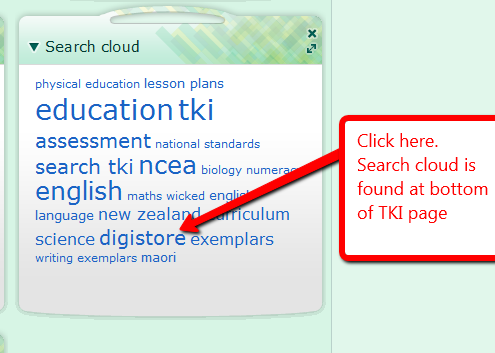
Once you are logged on to TKI scroll to the bottom of the page and click on the digistore.

The very first time you do this you will need to have your school log on details for logging on to the digistore. Once you have put this in, every other time you will only have to sign into TKI, and you will be able to access the digistore without having any further log on necessary.

Once there explore around, especially take notice of the wiki, which is a great place to go to, to learn various things about how the digistore operates.


After you have had an exploration time you can begin to build your own learning pathways that can later be shared with students. Today I have begun to do that, I was keeping in mind the needs of my students and the poetry topic we are going to be doing.  I made a folder called Poetry and then I added various learning objects I found to the folder.  These together make up my learning pathway. 

 Inside my learning path there are the learning activities for my students to engage with.


Before I added the learning activities I had clicked on View details to check it out, you do need to work through the activity yourself to decide on its relevance.


Having worked through the above activity, I am impressed and I know it will be a valuable addition to the unit of work.

When my learning path is ready, I post a link to the digistore on my wiki,  on the poetry page, for the students. I have placed the pin there that they will need to access the learning pathway.  They only need this pin to access it, they do not need to log on with passwords or emails.  


I am now looking forward to trying out the learning pathway I have created with the students when the right moment in the unit arrives.

If you have not tried digistore then perhaps start with this slideshare presented by Suzie Vesper at #Ulearn11. She explains it all far better than myself! However I was practising using Jing rather than the snipping tool I usually use!  Thanks Suzie for the enthusiasm and great presentation.


Saturday, October 22, 2011

First Taste of a ULearn Conference.


I have just returned from an amazing three days of professional learning at ULearn 11.  It was outstanding as a learning experience and sweeter still because I had chosen to do it myself.  I mainly funded it myself, although my school did make a contribution which was gratefully accepted! To think a year ago, I had never heard of ULearn. Thanks to an Australian teacher who made me curious enough to find out more I entertained the idea of attending, and did.


The keynote speakers were all excellent, however my favourite one was Simon Breakspear and it is to his keynote that I will return.  His ideas were inspiring, some of his imagery memorable.  What an amazing speaker, he knew how to reach his audience and engage them. I felt he deserved a standing ovation!  I should have stood and given him at least a one person standing ovation! I hope his speech will be put on Edtalks, I want to listen to it again and reflect further.  In the meantime I hold an image of a dandelion in my mind.  I will come back to it to a post all by its own.

In the breakouts each of the teachers presenting, were great models of organization and excellent presenting.  I marked them all at the top of the scale: they had prepared, were articulate and had a worthwhile something to share.  Well done to each of them.  I listened of course to only a few of the many options. Not my first choices as I was about 36hrs late when the choices went live online.  However I am sure I was not short changed. I look at my planner sheet of breakouts now, and I admit I am a little hazy as to what each speaker said.  However my mind is brimming over with thoughts and ideas to use in the classroom or to think about.

I attended:
·         1. Our Journey and E-learning tools for pre-teens
·         2. Ingenious ways to use Google Docs in the classroom
·         3. iPhone, iPad, iPod Touch, iLearn
·         4. Bringing Literacy to You: transformative possibilities for teacher professional learning.
·         5. QR codes for connected teachers
·         6. The e-Learning Classroom Project
·         7. The Digistore.

I went to the Digistore workshop by accident! It was the last workshop of the conference, I was in a rush, read the event centre incorrectly and found myself in the wrong place. I had been meant to go to Interactive Media – Gaming for Schools on the Cutting Edge (The Easy Way).  I had chosen it because it was something I knew little about and thought it might push me!  However I was very satisfied with the Digistore presentation, and have it as a top priority to use. It is copyrighted so it is  only available to New Zealand schools.  I knew about it, but had sort of ignored it, now I can’t! 

I was inspired by the Literacy presentation – No 4 – and I will explore it further. There is professional development linked to it, if I chose, so I will think about it.  Earmarked for another post.
No 6 -The e-Learning Classroom Project sounded amazing, and I was somewhat envious of the teachers who have grouped together in this project.  This too is earmarked for another post.

All the other breakouts were at the least interesting and at the best inspiring.  I know I want to take the time to go back and explore the notes online from each speaker, and refresh my mind on what I heard.
There were a huge group of people, over 1500 at least. I met only one person that I knew in that ever changing sea of faces!  However as we sat on buses, queued up in lines, sat beside each other there was always someone to chat with.  

Tuesday, October 4, 2011

The Book Whisperer.

I have just finished reading this excellent book by Donalyn Miller.  I found it easy reading, and was through it in a couple of days.  However I am now intending to do a re-read and gather up what I missed in the first reading.


 I grew up in the'50s where I was forever scrounging and seeking out books that weren't there. No town or school library, and a meager class library. Oh to have been in such a classroom as D Millers. She believes that students should have plenty of books available to them to read, and that they should be of their own choosing.  She also believes that this type of reading can be done during the school day. Now that kind of thinking is not foreign to me, New Zealand schools have long been places where we could choose the materials we teach with.  We have no prescribed basal readers or course that we have to follow. Just standards our students must reach. During my teaching career students have always chosen their own books to read in class.  This said, D Miller is advocating more than that, and that is where I found her book helpful.

I have recently become aware of the Daily Five and Café books by the sisters Gail Boushey and Joan Moser, and have implemented their ideas as well as I can. Of course as always, it was a fine tuning of my teaching rather than a radical shift, especially with the Café book.  However the Daily Five did involve some small radical changes – throwing out many desks for one!  The Book Whisperer calls for more fine tuning, and it challenges me as well.

Daily Five is working well, its magic, as all of we teachers who have implemented it can attest to.  In spite of this I still had a query in my mind as to the accountability of students in their reading.  The Book Whisperer answers this question for me.  If you are wondering about it then read the book, like me you will find answers.

I admit I have never been a great reader of children's literature, I enjoy the books I read to my class and there it stops. I now realise I need to read more of them, so I am starting with a goal of one per week. I have just grabbed from our school library Inkheart by  Cornelia Funke. D Miller mentions it in her book; also one of my reluctant girl readers mentioned it yesterday as a favourite book for her.  As this year has been a year of difficulty for me in trying to hook in some girls to reading, I thought this is a good place for me to start.

Some main points that I take from this book are:
·        The students need a wide variety of books to choose from – as each student will have differing tastes.  D Miller has her own vast class library that she has paid for.  I don’t have the time to build that library – I retire in a few years – however I have some books in our class library, we have a good school library, we visit as a class the local district library once a fortnight and we can loan 30 books from our National library for a 6 week time period. 
·        She has a very good system for organising her class books. She does this according to genre and has a system of stickers and numbers that easily allow for additional books with no changing around of the books already there.  I am going to organise the books I do have in the way she describes. It might not be until the summer break, but I will do it.
·        She has  high expectations for her students.  She sets the goal at the beginning of the year for the students to read 40 books.  Read that is! She allows that a reader will pick up a book and not like it and its okay to discard. ( I notice on Goodreads she has her own shelf for such discards.) Next term, is going to be short, I think I will set 7 -8 books for my class. In February as we begin our school year, it will be 40.
·        She has an effective system of accountability.  She has her students use a reader’s notebook and has a simple way of recording what they read.  I like this and I am going to implement it next term.  Once a week they write her a letter type response to the book they are reading and she replies to this. I need to explore that further in my second reread of the book.
·        She reads many children’s books so that she can match a student to a book.  I am sure that’s not the only reason she reads them, she is obviously a booklover full stop!  For me this is the most challenging aspect.  I am a booklover too, but prefer to read what I like in my own time.  As a result of reading this book though, I am going to change that, as I mentioned above.
I highly recommend this book to all teachers, and as one teacher on Twitter suggests, all administrators!

Wednesday, September 7, 2011

#Daily5 in Action

A video of my 10 to 13 year olds using the spaces made by throwing out some of the desks from the classroom.
I am really pleased with the space that has been freed up, plenty of space for individuals to spread out, and we have a large meeting area. I suspect I will never go back to a desk per student in a classroom.

Tuesday, August 30, 2011

Class Engaged in #Daily5.

My class have all voted in favour of the way we are managing the Literacy section of the day. I vote for it too!

Saturday, August 27, 2011

Ten Week Paid Sabbatical.


At the end of last week I found out I was one of the small group of fortunate teachers in New Zealand to be awarded a 10 week paid sabbatical in 2012.  Half the time is for learning and half the time is for relaxing and living a leisurely life!  I am delighted to be given the time. I really look forward to it.

                                                                   
'Digital Learning Environment' photo (c) 2010, Dan Zen - license: http://creativecommons.org/licenses/by/2.0/


My goal for my sabbatical is:

To investigate how I can use tools of the twenty-first century to develop in my Year 5 – 8 students, digital literacy and network literacy.
To investigate how I can do this in a way that empowers them to be intelligent and critical producers and consumers of a full range of media texts.

The questions I will investigate are:

·         How can I effectively use digital story-telling, podcasting, vodcasting, voicethread and other tools to empower my students  to be critical thinkers about what they and others produce?
·         Are there benefits to using such sites as Facebook and Twitter in a primary classroom?  What other ways are available for networking and collaborating?
·         How can I develop the reading, writing, listening, speaking, viewing, and presenting abilities of my students through these tools?
·         How can these tools meet the diverse needs of students in our senior school?
·         How can I encourage a process and product that empowers students to engage in work that has the mark of excellence? 

I will explore:

How other teachers are already using these tools through reading about their experiences with them on their blogs and wikis and attending webinars.  I will read books and articles from teacher magazines that refer to the literacies I am exploring.
A book called, Digital Storytelling by Richard Lambert and Adam Brice to develop my ideas and learn from the experience of those who have already been very successful in the digital storytelling field.
Each tool I learn about I will ‘play’ with, developing my own skills so that I can share them with my students.

·         


Wednesday, July 27, 2011

My Classroom is Coming Together.

Here is a video of what my classroom is beginning to look like.  Most of the desks have gone.  I decided I didn't want any student to have a tray in the desk, as I didn't want anyone to be able to claim a desk as "theirs".  I had to do some problem solving with where the students would keep their exercise books, pencil cases etc.  I am hoping my solution will work.  A classroom always feels good before the students hit, once they are there it becomes quite different.  So it will be interesting to see how we all fare in this new layout!!

So my classroom is almost set, now I need to get my planning ready to begin the Daily Five.  Here is a short video to show some of my changes, forgive the rather inane commentary.  I need to work on that.


Any suggestions you may have will be welcomed and listened to.

Monday, July 25, 2011

Redesigning the Layout of my Classroom.


It is going to be a larger task than I thought.  Before I get to the fun part I am going to need to do a major clean out.  There are things that need to be thrown to the recycling or at least placed somewhere else, so that I can make room for new needs. 

I had thought we had some tote tray storage but someone else is happily using them, so I am going to need to clear shelves so that students can keep their things there.  In fact I don’t want anyone to have the tote tray in a desk. It might make them think it is “their” desk. 

So tomorrow the big throw out begins!


Friday, July 22, 2011

Classroom Changes Afoot.


Holidays are when ideas begin to mull around in my head.  The summer holidays usually are the worst!  I make huge plans, and then I return to school, and reality hits!  It’s then I find the nitty gritty of implementing those plans takes a lot more than I anticipated in those lazy, hazy days of summer.

However, this isn’t the summer break, it’s the two week mid-winter break.  Ideas of how I want to make changes are entering my mind.  I am blaming it on the fact I sat in an office for last term instead of a classroom.  Normally my mind is mush at the end of a term and ideas have fled.  Oh, and the second culprit, Twitter.  It brims over with such great ideas.

Firstly I got drawn in by the idea of the Daily Five.  It’s a way to organize and structure the literacy programme, as shared by Gail Boushey and Joan Moser in their books, The Daily Five and The Café Book.  I see there is a possibility of structuring Maths in a similar way; however I will leave that for the time being. 
This structural idea appeals to me:
ü It encourages students to be responsible and independent. 
ü It allows me time to work with individuals and groups. 
ü There are also times when I can meet for whole class input. 
ü Once I get organized each student will have their own goals that they are working towards.
ü  The Daily Five ensures that students keep those goals before them daily.  We have often previously set goals and somehow during the term they have been lost, only to be remembered when we reflect towards the end of term.

So that leaves plenty to get organized.  And I also need to make a general large picture of the social studies unit to be entered into for the coming term.  There are plenty of other ideas also rolling around inside.  Not new ideas, others have all been there before me, but I am walking the path for the first time.  Fortunately great teachers have shared places on the internet to explore and obtain more information.
Subsequently I looked at the two sisters website and noticed the designs of some of the classrooms. I heard in my head, “What if…..?”  What if I made some changes in the layout of the classroom. (I am a structural control freak, you need to know that!) I decide where the students sit, I carefully craft a seating plan each term.

But what if…. Every student didn’t have a desk.  Computers are wonderful in the classroom, but they take up room and they have to be where they can be cabled into the internet ports, although a wireless upgrade is hopefully coming very soon. I use a rather large kidney shaped desk, that I like but has a dangerous wobbly bit on it.  So I am thinking:
ü Get a jelly bean shaped desk I can use.
ü Find a two seater couch
ü Rearrange the class library
ü Organise how to store student gear.
ü Remove some of my filing cabinets
ü Gather up some cushions
ü Make up some listening boxes
ü Put my dibs on a  low table or two
ü Wonder how many actual desks to leave
My classroom is generally the last thing I organize.  My walls are never anything to write home about.  There are other things that take my time and energy.  But this could make a difference to learning and I am rather energized by the thought. 

There is a thought going around in my head about how students will cope with this.  I am thinking that I will pre prepare but nothing too radical until the students return.  Then I will get them to think about the classroom and what if…?  I will ask them to come up with a design, and get their thoughts on how many desks we need, where we could place things.


I already have my jelly bean desk.  I spotted it on Trademe, now I just need to organize the transport.  I will be able to use it for working with groups of students and it can also double up as a working area for them when I am not using it.  I have my eye on a 2 seater couch that will be local and easily picked up, and very cheap.  Nice.

Sunday, July 10, 2011

Creating the hub of my PLN

How do I organize the way I can tap into my PLN and other places that I use frequently ?  The hub of the network. That’s what PLN Challenge#6 is asking us to think about.  At first I was going to give it a miss, however I decided to do a little “spring” cleaning. 

I now have things slightly more accessible and I am happy with it.  I think that’s the essential part, it has to work for you.  That said if others post on this, I will be looking at what they have done, as something may stand out to me as a great idea.

This is how my homepage looked before the spring clean.  It worked, however there were a few double ups and it didn’t have that kerb side appeal!

Now I have changed the classic theme and put in Ninety mile beach. Far more relaxing and refreshing to view.

I like to work with tabs so across the top I have:
                                Diigo
                                Hootsuite
                                My class and teacher blog
                                Igoogle   (my homepage)
On the next line I have:
                                Evernote clipping tool
                                Bit.ly url shortner
On the next bar there is:
                                TKI  (Website for NZ teachers)
                                My SchoolTube account
                                Ilearn  (Collaborative website.)
                                NNWP writing lessons Ning
                                My You Tube site
                                My Glogster site.

I have now put two pages on my iGoogle site after reading the challenge post.  I have shifted my personal interest  links to this page.  On the homepage I have added in a feed from my Google Reader and Facebook.  I do have some educational links on Facebook, however family things also come in there and I like keeping an eye on it, so have given it prime real estate! I may add the Diigo bar as well later on, the problem when we have our laptops upgraded as teachers, is that it has to be set up again and some things get missed.

Now as I do this I acknowledge there are a few places in my links I haven't been to recently.  Like clothes we don't wear I guess they should be deleted. However I am going to hang on to them for awhile longer and try them on again!

Now when I turn on my computer at school in the morning, a good cup of coffee and I will be ready to go.
Related Posts Plugin for WordPress, Blogger...